California’s SB 37 (2025) represents the most significant update to attorney advertising and solicitation rules in decades. While many lawyers assume these rules apply only to ads or billboards, SB 37 squarely impacts law firm websites, landing pages, SEO content, testimonials, case results, and even metadata.
If your website promotes your services, and nearly every firm’s does, it is legally considered advertising.
This guide explains what SB 37 is, how it affects your website, and how to bring your digital presence into compliance without sacrificing marketing performance.
What Is SB 37 and Why It Matter to Your Website
SB 37 updates California’s attorney advertising rules by amending Business & Professions Code §§ 6152–6157.2 to better reflect how law firms market online.
Key Reality Lawyers Must Understand
Under SB 37, your website is treated as an advertisement when it:
- Promotes legal services
- Encourages the public to hire or contact the firm
- Is published electronically (website pages, blogs, landing pages, etc.)
- Is created by the firm or by a third party on the firm’s behalf (agency, vendor, writer)
What This Covers
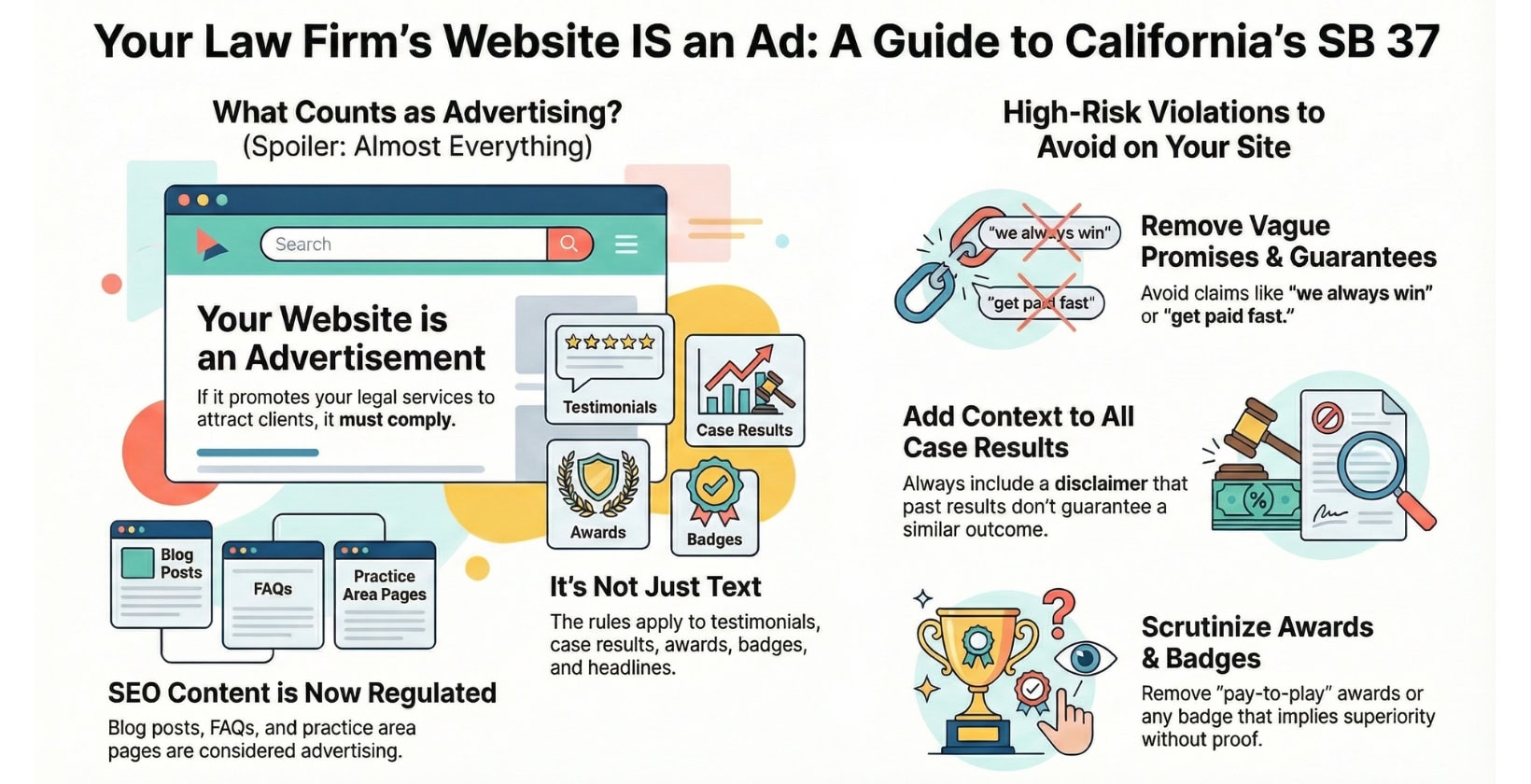
If it markets your firm, SB 37 applies – including:
- Practice area and location pages
- Blog posts and FAQs
- Landing pages and campaign pages
- Testimonials and reviews
- Case results and “past success” sections
- Awards, rankings, and badges
- Homepage headlines and hero claims
- Calls to action (“Free consult,” “No fee unless we win,” “Call now,” etc.)
Bottom line: If the content is designed to attract clients, it’s advertising, and it must be accurate, transparent, and defensible under SB 37.
Mandatory Website Disclosures Under SB 37
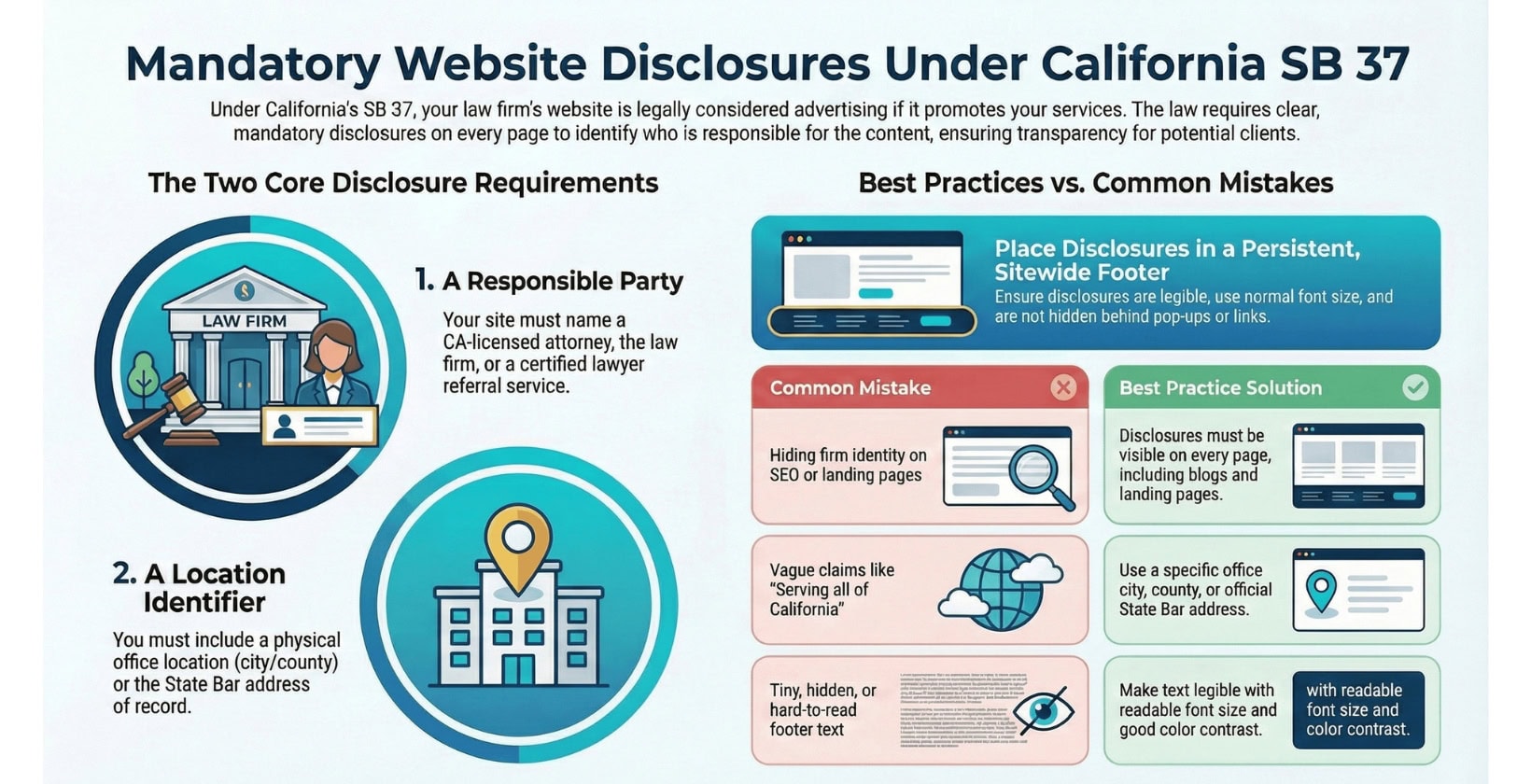
SB 37 requires attorney advertisements to clearly identify who is responsible for the content. If your site markets legal services, these disclosures aren’t optional.
Your Website Must Include
A responsible party, such as:
- The name of at least one California-licensed attorney, or
- The law firm name, or
- A certified lawyer referral service (if applicable)
AND
A location identifier, such as:
- An office location (city, town, or county), or
- The State Bar address of record
Common Website Mistakes hat Create SB 37 Exposure
- SEO landing pages that hide or omit the firm/attorney identity
- “Serving all of California” claims with no office location or address reference
- Practice area pages that read like ads but don’t identify responsibility
- Footers missing (or not clearly showing) a responsible attorney name / firm identity
- Disclosures that exist but are tiny, inconsistent, or effectively hidden
Best Practices
Put disclosures in the footer so they appear sitewide – but make sure they are:
- Legible (normal font size, readable contrast)
- Persistent (visible across pages, including landing pages)
- Not hidden behind pop-ups, expandable toggles, or hard-to-find links
If a page can rank, get shared, or collect leads, it should carry the required identification and location disclosure.
Prohibited Website Claims: High Risk Violations
SB 37 prohibits advertising that is false, misleading, or not objectively verifiable. A lot of common legal marketing language creates risk because it promises, predicts, or implies superiority without proof.
Claims You Must Remove or Rewrite
- “We guarantee results”
- “Get paid fast or quick settlements”
- “We always win”
- “Top lawyer or best firm without objective proof”
- “Millions recovered for clients without proof of recovery”
Why These Are Risky
- They predict outcomes or create an expectation of a specific result.
- They imply certainty or superiority (“best,” “top,” “always”).
- They are often not independently verifiable by the public.
- They can mislead prospective clients, even if the intent is marketing.
Rule of Thumb
If a claim:
- Can’t be independently verified, or
- Sounds like it applies to every case
It’s a compliance risk. Rewrite it to be specific, factual, and contextual, or remove it.
Do you want us to check if your law firm website is compliant with the SB-37?
Case Results and Testimonials: How to Use Them Safely
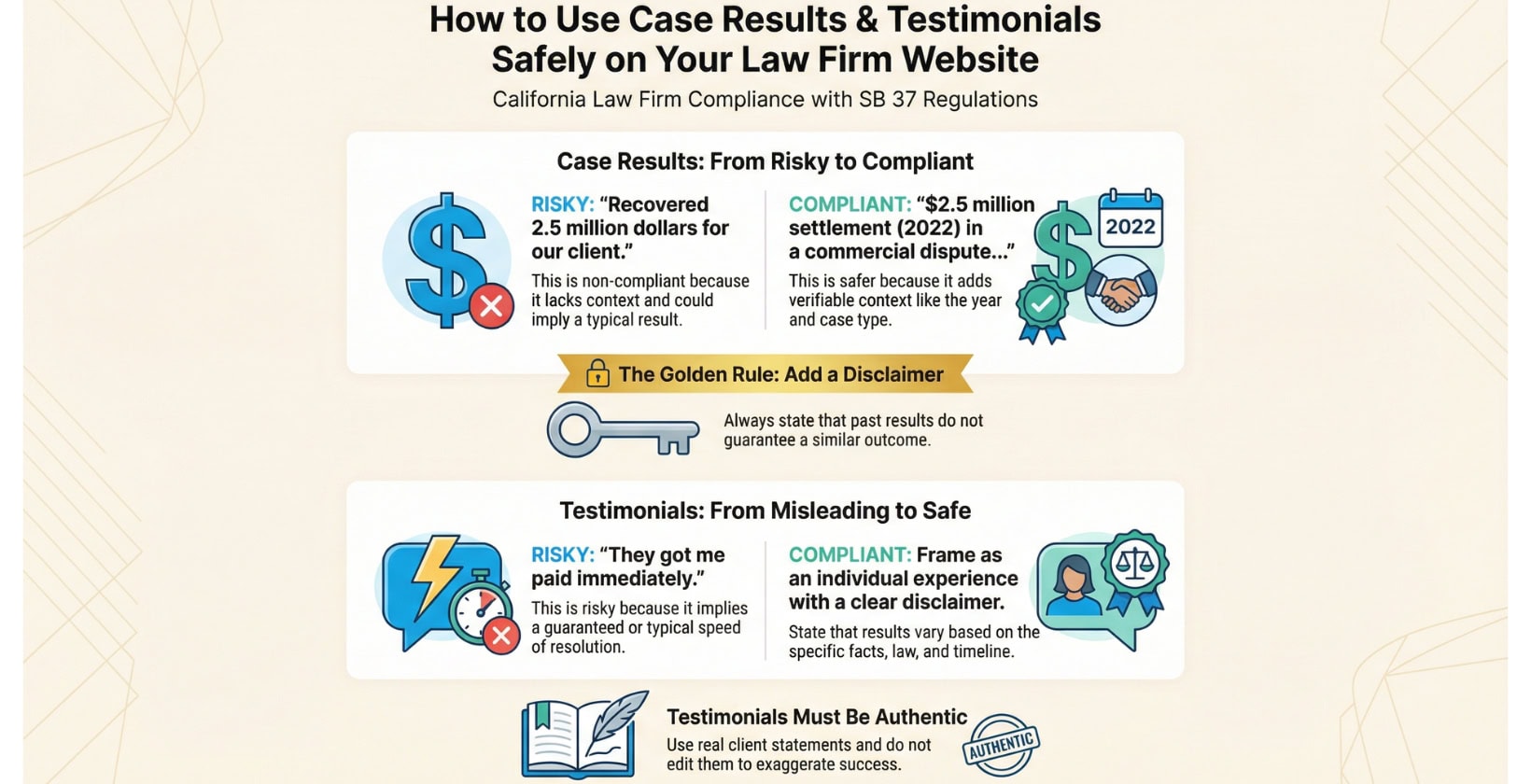
Case Results
You can share results only if they are:
- Factually accurate
- Objectively verifiable (you can back them up)
- Presented with context (what kind of case, when, and what mattered)
- Not framed as typical or guaranteed
Non-Compliant Example
Recovered 2.5 million dollars for our client.
Compliant Example
$2.5 million settlement (2022) in a commercial dispute involving multiple defendants.
*Past results depend on the specific facts and do not guarantee a similar outcome.*
Testimonials and Reviews
Testimonials are allowed, but they must:
- Reflect real client statements
- Not be edited in a way that exaggerates success
- Not imply guaranteed, immediate, or typical outcomes
Risky Example
They got me paid immediately.
Safer Example
Client testimonial reflecting their individual experience. Results vary based on facts, law, and procedural timelines.
Best Practice
Place a results disclaimer anywhere you show:
- Case outcomes/settlements/verdicts
- Testimonials and review quotes
- “No fee unless we win” or “past success” messaging
This keeps the message transparent, reduces “misleading impression” risk, and protects your marketing from compliance exposure.
Awards, Rankings and Badges: A Hidden Compliance Trap
Awards, rankings and “recognition” badges can create compliance risk because they often imply superiority without clear, verifiable standards. SB 37 treats these claims as potentially misleading unless they’re transparent and substantiated.
Award References Are Risky When
- The organisation sells recognition (pay-to-play or “marketing awards”)
- The selection criteria are unclear or not publicly explained
- There’s no meaningful peer-based or objective review process
- The award is not widely recognised in the legal profession
- The badge creates a “best / top / #1” impression without proof
Examples That Commonly Create Risk
- “Top 1% of Lawyers”
- “Best Attorneys in California”
- “Elite,” “Premier,” “Top Rated,” or “Best of” badges with vague criteria
- Pay-to-play directory icons or “featured” labels that look like awards
How to Use Awards Safely
If you choose to include awards, make them specific and verifiable:
- Name the awarding organisation (no generic “Top Lawyer Award”)
- Include the year received
- State the selection criteria (or link to it)
- Clarify what it does not mean (no guarantee, not typical, not a promise of outcome)
- Avoid superiority language (“best,” “top,” “#1,” “leading”) unless you can objectively support it
Rule of thumb: If you can’t clearly explain who gave it, when, and how it was earned, it’s safer to remove the badge than to defend it later.
SEO Content Is Advertising, Yes, Even Blog Posts
Many firms miss this: under SB 37, SEO content counts as advertising when it’s designed to bring in clients. A blog post is advertising if it:
- Promotes your firm
- Links to services or practice pages in a way meant to drive leads
- Encourages contact (CTAs, phone number prompts, “free consult” language)
What This Means in Practice
- No outcome predictions (“We’ll win,” “You’ll get paid,” “You’ll recover X”)
- No misleading or fear-based headlines that overstate what the law guarantees
- No exaggerated success stories or “typical result” implications
- Disclosures still apply wherever you mention fees, results, urgency, or timelines
SEO Tip
You don’t need aggressive claims to rank. Educational content performs just as well and is safer when written to inform, not promise.
Third Parties and Marketing Agencies Your Liability Still Applies
Outsourcing doesn’t outsource responsibility. Even if your website or content is created by:
- An SEO agency
- A content writer
- A lead-generation vendor
You remain responsible under SB 37 for what gets published in your name.
If a third party posts non-compliant messaging on your behalf, the exposure lands on the law firm – not the vendor. That includes misleading fee language, unverifiable results, exaggerated “best/top” claims, and missing disclosures.
That’s why compliance-aware marketing matters: you’re not just buying content – you’re building public-facing statements your firm must be able to stand behind, verify, and defend.
SB 37 Website Compliance Checklist
Use this checklist to review your law firm website page, landing page, or blog post:
- Responsible attorney / firm identification (clear firm name and who is responsible for the content)
- Office location(s) / required address details (accurate and consistent across the site)
- No guarantees or outcome predictions (avoid “we will win,” “you will recover,” “results guaranteed”)
- Case results shown with context (year, case type, key facts at a high level, and “results vary” language)
- Testimonials include proper disclaimers (individual experience, not typical, results vary based on facts and law)
- Awards/rankings are verified or removed (no pay-to-play, vague criteria, or superiority implications)
- SEO content is truthful and educational (blogs don’t become sales pages with implied promises)
- Calls to action are not misleading (no pressure tactics, false urgency, or “instant payout” implications)
- Disclaimers are present where needed (placed near the claim – fees, results, timelines, “free consult,” etc.)
If any item is unclear, treat it as a risk signal: clarify, add context, or remove the claim.
How Blue Summit SEO Helps Law Firms Stay Compliant
At Blue Summit SEO, we design law firm websites and content strategies that:
- Support SB 37 compliance with clear, non-misleading and include disclosures where required
- Protect SEO performance without risky “marketing fluff”
- Create ethical conversion paths (CTAs, forms, call tracking language) without overpromising outcomes
We do not just market law firms. We build defensible digital assets aligned with California regulations and State Bar guidance.
Do you want us to check if your law firm website is compliant with the SB-37?
Final Takeaway
SB 37 does not mean lawyers must stop marketing. It means marketing must be accurate, transparent, and verifiable.
A compliant website:
- Builds trust with the right clients
- Reduces regulatory risk and complaint exposure
- Protects your license by avoiding misleading-by-omission language
- Strengthens long-term SEO with content humans can rely on
If your site has not been reviewed since SB 37’s passage, now is the time.
Disclaimer
This content is for marketing compliance education only and does not constitute legal advice.